
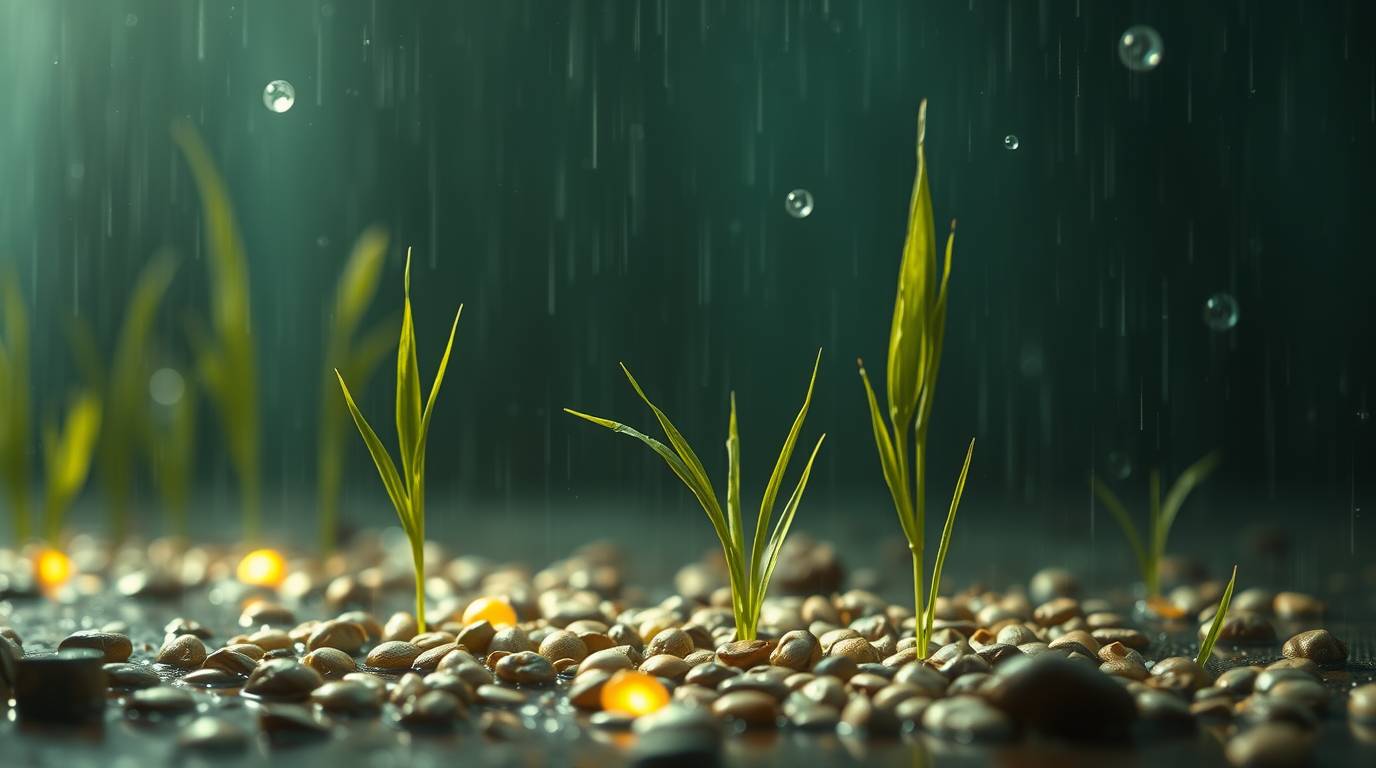
For centuries, rain has symbolized renewal and growth in nature. Farmers eagerly wait for seasonal rainfall, knowing that water brings life back to dry soils and dormant seeds. But recent scientific discoveries suggest that rain may do more than simply provide moisture. Researchers have now found evidence that plant seeds can actually sense the acoustic vibrations produced by falling raindrops and respond by accelerating germination.
This fascinating discovery changes how scientists understand plant behavior and reveals that seeds are far more sensitive to their environment than previously believed.
A recent study conducted by researchers Nicholas Makris and Cadine Navarro from the Massachusetts Institute of Technology (MIT) demonstrated that rice seeds exposed to rain-like sound vibrations germinated significantly faster than seeds that were not exposed to such vibrations. Their findings suggest that seeds may use sound as an environmental cue to prepare for favorable growing conditions.
Seeds and the Hidden World of Sound
Humans perceive rain through hearing, but plants do not possess ears or auditory organs. Instead, seeds appear to detect the physical vibrations associated with sound waves. These vibrations travel efficiently through water and soil, allowing submerged or buried seeds to experience pressure changes generated by falling raindrops.
In the experiment, nearly 8,000 rice seeds were submerged in shallow water and exposed to simulated raindrops over six days. Researchers carefully controlled the size, height, and intensity of the falling drops to recreate natural rainfall conditions. Hydrophones recorded the underwater acoustic signatures to ensure the experiment accurately represented real rain-generated vibrations.
The results were remarkable. Seeds exposed to rain vibrations germinated up to 37 percent faster than seeds grown under identical conditions without acoustic stimulation. This indicates that seeds are capable of sensing environmental vibrations and using them as signals to initiate growth.
How Seeds Detect Rain Vibrations
The researchers believe that specialized cellular structures known as statoliths may play an important role in this process. Statoliths are tiny gravity-sensing organelles found in certain plant cells. Normally, they help guide roots downward and shoots upward through gravitropism.
When sound vibrations from falling raindrops travel through water or moist soil, they can physically disturb these statoliths. This mechanical stimulation may activate biological pathways that trigger germination.
Interestingly, seeds positioned closer to the water surface experienced greater statolith displacement and showed the highest germination rates. This suggests that seeds near optimal moisture conditions are especially responsive to acoustic signals associated with rainfall.
Why Rain Sounds Are Stronger Underwater
One reason this mechanism may work so effectively is that sound travels differently through water than through air. Water is denser, allowing pressure waves to move more efficiently and with greater intensity.
The pressure generated by raindrops striking shallow water can reach hundreds of Pascals. In contrast, a normal human conversation typically produces only a tiny fraction of that pressure. According to the researchers, a seed located just a few centimeters from a raindrop impact may experience sound pressure comparable to standing near a jet engine in the air.
Such intense acoustic energy may provide seeds with reliable information that substantial rainfall has arrived, signaling favorable conditions for survival and growth.
Implications for Agriculture and Ecology
This discovery could have important implications for agriculture, ecology, and plant science. Understanding how seeds respond to environmental sound may help scientists develop new methods for improving crop germination and productivity.
Rice was selected for the study because its growth behavior shares similarities with many other plant species. Researchers suspect that numerous seeds may possess comparable sound-sensitive mechanisms.
If future studies confirm this, acoustic stimulation could potentially become a tool for enhancing seed germination in farming systems, especially in environments facing unpredictable rainfall patterns due to climate change.
The findings also deepen scientific appreciation of plant intelligence and environmental responsiveness. Plants may not “hear” in the human sense, but they clearly possess sophisticated ways of detecting and reacting to physical signals around them.
A New Perspective on Plant Life
The study offers a poetic scientific explanation for an ancient observation: rain awakens the earth. What once seemed symbolic now has measurable biological foundations. Seeds buried beneath the soil are not passive objects waiting for water alone; they are active organisms capable of sensing the world around them through vibration and mechanical force.
As research into plant communication and sensory biology continues, scientists are increasingly discovering that plants interact with their environments in ways once thought impossible. From responding to touch and light to detecting sound vibrations, plants continue to challenge traditional ideas about intelligence and awareness in living systems.
The discovery that rain sounds can awaken dormant seeds opens a new chapter in plant biology and reminds us that nature often communicates through mechanisms humans are only beginning to understand.
References
- Nicholas C. Makris, & Cadine Navarro (2026). Seeds accelerate germination at beneficial planting depths by sensing the sound of rain. Scientific Reports, 16, 11248. https://doi.org/10.1038/s41598-026-44444-1
- Gagliano, M., Mancuso, S., & Robert, D. (2020). Towards understanding plant bioacoustics. Trends in Plant Science, 25(12), 1137–1140. https://www.cell.com/trends/plant-science/abstract/S1360-1385(12)00054-4
- Karban, R. (2015). Plant sensing and communication. University of Chicago Press. https://www.degruyterbrill.com/document/doi/10.7208/9780226264844/html

